
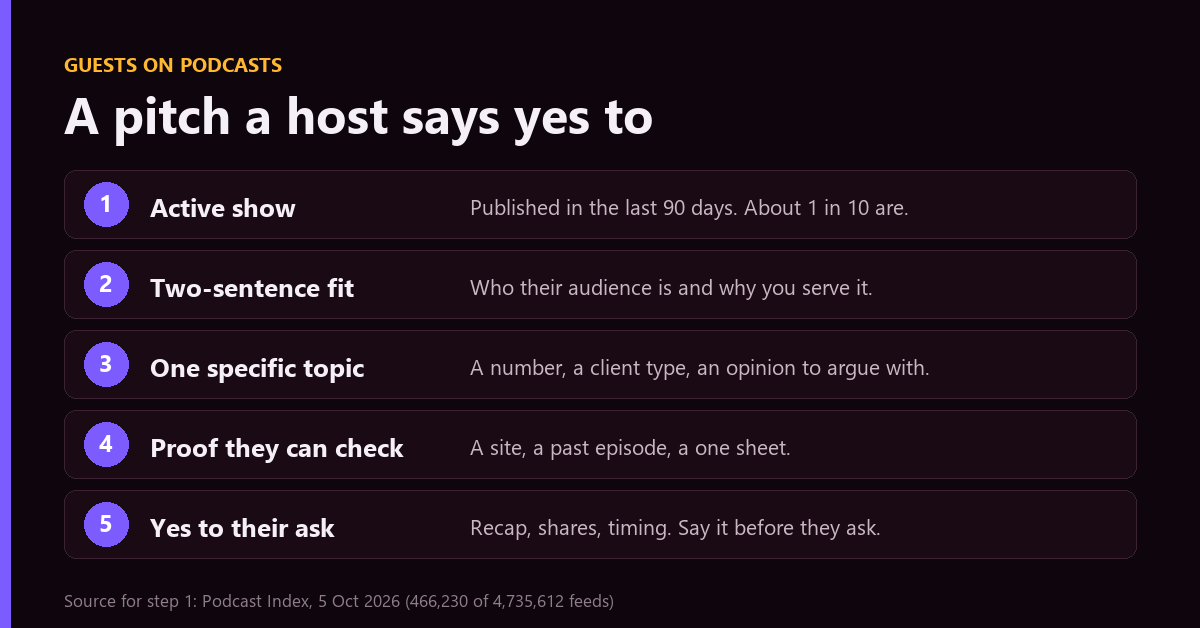
Pitch shows that are still publishing, prove in two sentences that you fit their audience, name one specific thing you will talk about, and say yes to what the host needs from you after the recording. Most pitches fail on that last part, and almost nobody writing pitch advice mentions it.
We run the Unscripted podcasts, so we read pitches every week. Here is what we look for, plus what a booking agency founder and a guest who books himself on a schedule told us on the record.
Pitch the shows that are actually publishing
Most podcasts are not live. On 5 October 2026, Podcast Index listed 4,735,612 podcasts in its index, and only 466,230 of them had published an episode in the last 90 days. That is roughly one in ten. A pitch to a show that stopped in 2023 is not a rejection waiting to happen. It is just gone.
So before you write a word, check the latest episode date. Then go smaller than you think. Victoria Bennion, who founded the Best Podcast Guest Booking Agency, said her clients often arrive wanting the biggest shows:
“where podcasts can be so niche, you don’t need to be on Oprah or Joe Rogan or whatever to see benefits from a podcast interview strategy. You can really really hone in your marketing and talk to the people that need to hear from you.”
— Victoria Bennion, on Unscripted Small Business
A show with four hundred listeners who all run the kind of business you serve is worth more than a big general show where you are the twelfth marketer this month.
Be specific enough that the host can check you
Hosts look you up. Victoria was blunt about who should not be pitching yet: “if say a host is gonna look you up, they’re not really sure what you do… then no.” Her advice if you don’t have a solid offer worked out: “Hold off on the podcasts till you do.”
Specific also means personal. One of her clients, a coach, talked about loving cats on an interview. After it went live, someone got in touch and said they knew she was the coach for them. Victoria’s take: “you’re gonna attract the right people to you and also probably repel the others, which is fine.”
In a pitch, that turns into one sentence a host can verify. Not “I help businesses grow.” Something like the number you moved, the client type you serve, or the opinion you hold that their audience will argue with.
Write it yourself, because hosts can tell
Inboxes are filling with machine-written pitches, and hosts notice. Victoria said hosts tell her “they are getting so many more [pitches] now. Very AI generated [pitches].” Her agency uses AI behind the scenes, but not in the pitch itself: “we still pitch fresh.” She sees that as an opening rather than a problem, a chance “to bring that humanness into the [pitches] and through using that still standing out.”
Here’s the quick test. If your pitch would make sense sent to any show in the category, rewrite it until it only makes sense for this one. Reference an actual episode. Say what you would add that their last three guests didn’t.
Know what the host will ask of you, and say yes in advance
This is the part pitch guides skip, and it is where we see the most deals stall. Every show wants something back. Ours is written down. When a pitch lands, our standard reply explains that we release the episode the same day or the next day, that we will send clip collaboration requests, and then asks whether the guest has a blog, because we write an interview-style recap for the guest to publish. We require that recap to go live on the guest’s site before the episode does, so the show notes, the YouTube description and the newsletter all point to it on day one.
A guest who already knows that, and says so in the pitch, goes to the top of the pile. Wyatt Bonicelli came to us through PodMatch for his first podcast interview, and his reply at the end of the recording is the one every host wants to hear:
“Should be able to get that up by tomorrow night for sure. if you can get it to me today, I’ll try and get it up today. Definitely want to get it off the checklist and get it live.”
— Wyatt Bonicelli, after recording his Unscripted SEO episode
Other shows will ask for different things: sharing the episode, a guest fee, a pre-interview. Find out before you pitch and say yes in the pitch. If you want to know what a host can and can’t put in their show notes for you, read the show-note link vetting editors apply.
Your one sheet is a sales document too
A one sheet is the single page that goes with your pitch: who you are, what you talk about, where you have been heard. Treat it as more than a formality. Victoria told us about pitching an early client to a leadership show:
“they’d kind of taken the one sheet that I sent over as a C V, I guess, a resume … do you think he’d deliver some webinars for us? And so he got this business opportunity.”
— Victoria Bennion
The host was also a buyer. Some of yours will be too. Write the one sheet so it works for both readers.
Run it like a small pipeline, not a campaign
The guests who get booked regularly treat pitching like any other sales task: a set amount of time, every week. Dave Valentine of Finch, who has sold nine of eleven companies, described his:
“I have someone on my team that she spends an hour a week and she’ll reach out to 10 people maybe, maybe eight. And out of those, I’ll get four to six people that are like, hey, we want you to be on the podcast.”
— Dave Valentine, on Unscripted SEO
That is his own count, not an industry benchmark, but it shows the shape: small, steady, targeted. He found shows through matching platforms, naming PodMatch and matchmaker.fm, and his verdict on the result was simple: “I’ve gotten so many leads out of being a guest on podcasts. It’s absolutely absurd.”
What we can’t tell you
We don’t have a reliable industry response rate for cold podcast pitches, and Dave’s four to six out of ten is one team’s self-reported number. Podcast Index counts feeds, not quality, so “published in the last 90 days” tells you a show is alive, not that it is any good. What we can tell you is what moves a pitch from our inbox to our calendar: a fit we can check, one specific idea, and a guest who already said yes to the recap.
So pick ten shows that published this month, read one episode of each, and send ten pitches that could only have gone to that show. If you would rather someone else run the list, that is what our podcast guest booking service does. And if you are still deciding whether guesting is worth it, start with what one recording actually produces.