
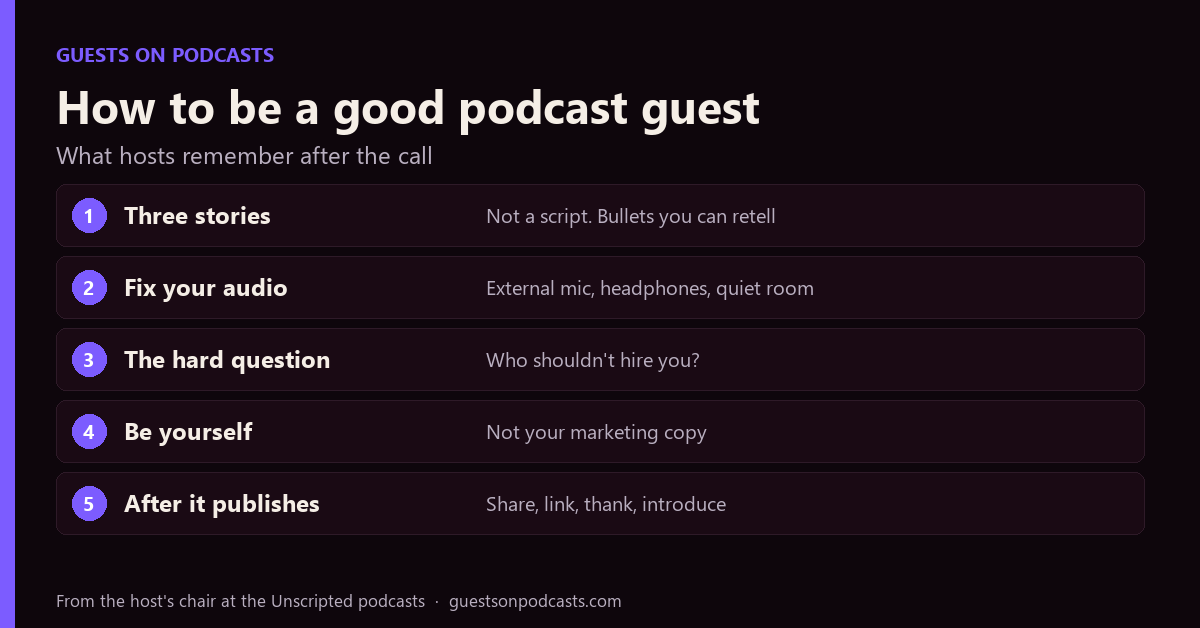
A good podcast guest prepares stories, not a script, fixes their audio before the call, answers the hard question honestly, and does their part after the episode goes live. That’s most of it. Hosts forgive nerves. What they remember is a guest who gave them nothing to clip, or who vanished the day the episode published.
We host the Unscripted podcasts, so we sit on the other side of this every week. Below is how to prepare for a podcast interview from the host’s chair, plus what Victoria Bennion, founder of the Best Podcast Guest Booking Agency, told us about the guests she’s coached since 2019.
Prepare three stories, not a script
The single most useful thing you can bring to an interview is a short list of stories you can tell well. Victoria’s agency added a speech coach to its service, and when we asked what that coach tells people, the answer came back in two words, twice:
“Share stories. Share stories. It helps you to be more memorable, helps to build connection with the listener. I mean we remember stories far more than facts. So come think about your best stories and bring them in your interview to illustrate.”
— Victoria Bennion, on Unscripted Small Business
So before the call, write down three: how you got into this work, one client or customer result you can describe in detail, and one time something went wrong and what you changed. Bullet points, not paragraphs. You want to remember the story, not recite it.
The script is the trap. Victoria told us about a client, a former teacher she expected to be comfortable on the mic, who “showed up to the podcast interviews with a script” and wanted the questions in advance so she could write answers to them. That’s the experience that pushed the agency to bring in a coach and run practice interviews. A scripted guest sounds like a press release, and the host can’t steer the conversation anywhere useful.
Fix your audio before you fix anything else
You don’t need a studio. You do need to not sound like a laptop in a kitchen. Victoria’s list was short:
“it’s ideal to definitely have an external microphone, webcam, headphones, but you don’t have to spend a lot of money to do that.”
— Victoria Bennion
Headphones matter most, because without them the host’s voice bleeds into your microphone and onto the recording. Then, on the day:
- Join from a wired or strong connection, in a small room with soft things in it. Bare walls echo.
- Close every app that might ping. Silence your phone and put it out of reach.
- Use the browser the host recommends. Our shows record on Riverside, which records each person locally, so a shaky connection hurts less than you’d think. A bad microphone still hurts exactly as much.
- Join five minutes early and say a few sentences so the host can check your level.
Practise the questions hosts actually ask
Most hosts send topics, not exact questions, and some won’t send anything. You can still prepare for the shape of the conversation. On our shows, a few questions come up again and again, and they’re the ones guests stumble on when they haven’t thought about them:
- “Who are you and what do you do?” Have a two-sentence answer that a stranger would understand.
- “Who shouldn’t use your service?” This is the hard one. An honest answer builds more trust than anything else you’ll say. Victoria’s was specific: people still figuring out their business, and anyone without a solid offer to sell yet.
- The elevator question. We ask what you’d say if your perfect client stepped into a hotel elevator and asked what you actually do. Practise saying yours out loud.
- “What problem do you want a genuine answer for?” We end by asking guests for a question we can put to a future guest. Come with a real one.
Listen to one or two recent episodes of the show before you record. You’ll hear the host’s habits, and you’ll avoid repeating what the last guest said.
Show up as yourself, not as your marketing copy
Polish isn’t the goal. Victoria put it plainly: “you don’t have to be perfect, you don’t have to be the best speaker, you can just be yourself.” The coach on her team flagged one client, a copywriter, whose self-introduction was “very much a canned response,” and worked with them to bring it back to how they’d say it across a table.
The personal details are often what sells you. Victoria described a coach client who talked about loving cats on her interviews, and got an inquiry from a listener who said that’s how she knew this was the coach for her. You’ll attract some people and put others off. That’s the point.
A few habits that make you easy to interview:
- Answer the question first, then add the story.
- Keep answers to a minute or two, then stop. The host will follow up.
- Say numbers and names out loud. “We cut response time from two days to four hours” clips well. “We improved things” doesn’t.
- Don’t pitch. Mention your website once, when the host asks where people can find you.
Your job doesn’t end when the recording stops
This is where good guests separate from the rest. The host spent hours editing and publishing your episode. What you do in the week it goes live decides whether the host wants you back, and whether the interview keeps working for you.
- Send your links before the episode publishes: website, the one social profile you actually use, and a headshot.
- Share it the week it goes live, and tag the show. A guest who shares reaches the exact audience the host is trying to grow.
- Link to it from your own site. An “As heard on” page or a press page turns the interview into lasting proof, which we cover in what one recording actually produces.
- Thank the host by name and offer one introduction to another guest who’d fit their show. Victoria said hosts often pass good guests on to other shows. Make it easy for them.
Podcast guest questions we get asked
Short answers to the ones that come up most.
How long should I prepare for a podcast interview?
An hour is plenty for most guests: twenty minutes listening to an episode, twenty writing your three stories and your two-sentence intro, and a few minutes testing your microphone and headphones.
Should I ask the host for the questions in advance?
You can ask for topics. Don’t ask for a full question list so you can script answers. That’s the habit Victoria’s team coaches people out of.
What should I wear on a video podcast?
Whatever you’d wear to meet a client, in a solid colour. Small patterns can flicker on camera. Put a light in front of you, not behind you.
How to be a good podcast guest on your next booking
Before your next interview, write your three stories, plug in headphones, and decide your honest answer to “who shouldn’t hire you?” Then plan the week after it publishes as carefully as the hour you’re on the mic.
If you’re still finding the shows, start with how to pitch yourself as a podcast guest. If you’d rather someone else find and book them, that’s what our podcast guest booking service does.
Quotes are verbatim from the raw Riverside transcript of Victoria Bennion’s Unscripted Small Business interview, trimmed only for false starts.