

A Guest Spot Ranks You On Spotify In Hours
Jason Wade has tested it repeatedly: publish the episode, search the guest’s name, and it is already there. That is a citation and an entity signal — and almost nobody counts it.
Every SEO has had the conversation where a client asks how long this is going to take. Jason Wade, who runs the AI visibility and entity engineering consultancy Ninja AI, put that question to host Jeremy Rivera on the Unscripted SEO Podcast — what is the advice everybody gives in SEO? Jeremy’s answer was the standard one: a year or two. Jason’s point was that there is one channel where that timeline does not apply, and most brands have it filed under “nice exposure.”
Your Name On Spotify Within Hours
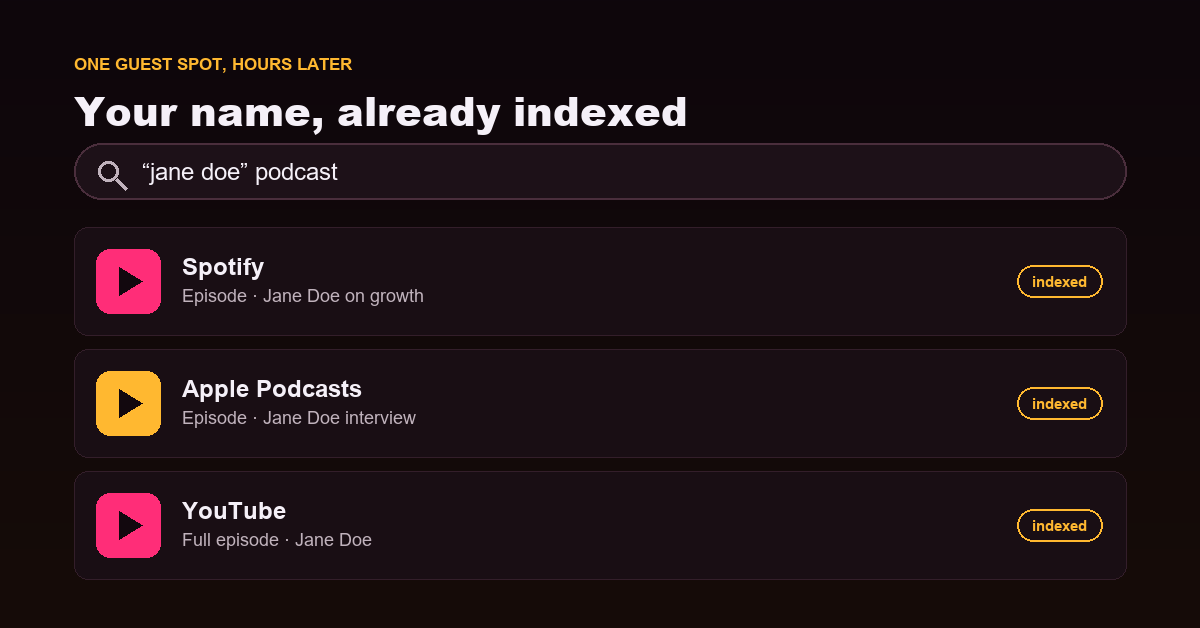
Here is what he actually said, in his own words:
“You know, it’s six months at the minimum, at the minimum, right? And I’m like, I did a podcast and it ranked instantly. Instantly… because it’s on Spotify, it’s whatever, right? Like nobody else is doing it. Literally, I’ve done it again and again, especially if it’s specific or it’s a unique name of a guest.”
— Jason Wade, Ninja AI
One honest note on the headline: Jason’s word is instantly, not “within hours.” Hours is the conservative version. He was careful to say it is repeatable — “I’ve done it again and again” — not a one-off fluke.
The qualifier matters as much as the claim. It works “especially if it’s specific or it’s a unique name of a guest.” You are not going to rank an episode for project management software on the day it publishes. You are going to rank for your name, your company name, and the specific phrases you used — which, for a founder or an executive being researched by a buyer, is the query that actually decides deals.
Why That Counts As An Entity Signal
An entity, in the sense search engines and language models use it, is a thing the machine has decided exists — a person, a company, a product — plus everything it associates with that thing. Your website is one input into that picture. It is also the least trusted one, because you wrote it.
A podcast appearance does something your website structurally cannot. It creates a record, on a platform you do not own, in which a named third party introduces you as an authority on a specific topic and then spends an hour treating you as one. The episode page, show notes, transcript and platform listings all carry your name next to that topic — an association formed in public, where a model can read it.
It is the same mechanism we unpack in how entity associations move rankings — the machine is not counting your assertions, it is counting the contexts you appear in and who put you there.
Jason is unusually alert to the downside of this, because he got it wrong himself. He had been publishing daily AI news posts, and they were his best-performing traffic. His own AI analysis told him to stop.
“It said, you need to stop doing these news things. I said, they’re my highest traffic. They said, that’s the… The AI said your top 10 things are news things. That’s the only reason you’re getting… So you’re getting the wrong kind of traffic.”
— Jason Wade, Ninja AI
He was training every engine on the internet to classify him as a person who comments on AI news, rather than a person you hire for AI visibility work. What you appear alongside, repeatedly, is what you become — a strong argument for being selective about the shows you say yes to.
Authority Is What Third Parties Say About You
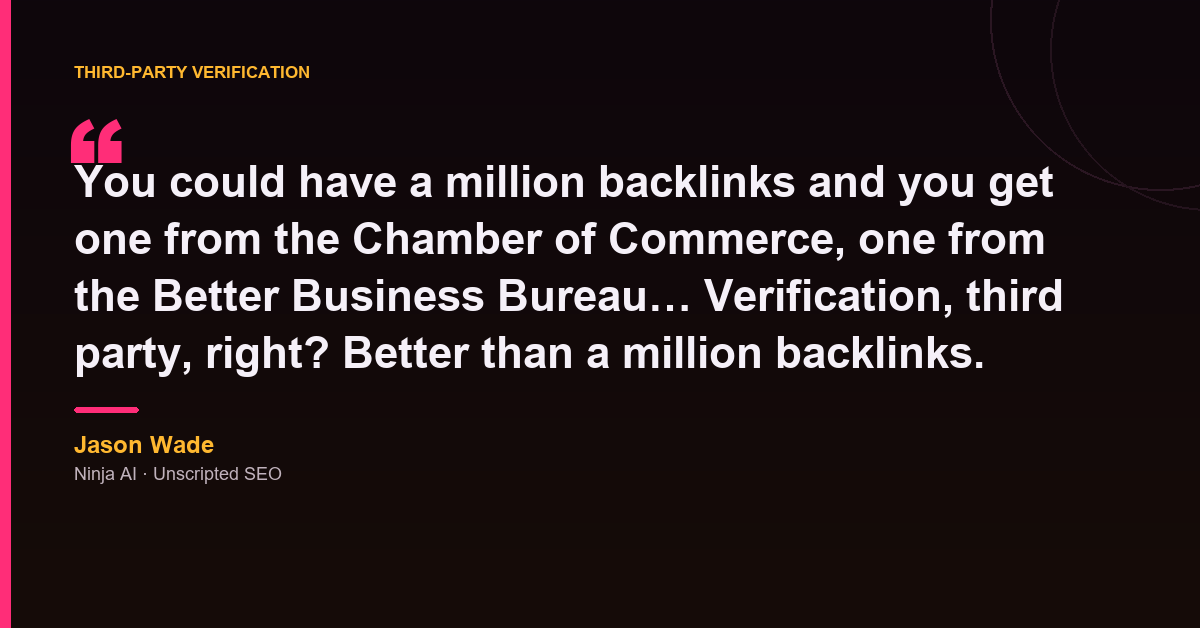
A note on sourcing. That heading is our framing of Jason’s position, not a sentence he said. What he actually argued, and the line we have put on the card, was about verification:
“You could have a million backlinks and you get one from the Chamber of Commerce, one from the Better Business Bureau, one from a blog post that you wrote and put up… Verification, third party, right? Better than a million backlinks. Because AI is like, we know these are all coming from India fibers.”
— Jason Wade, Ninja AI
The economics are worth sitting with. A million purchased links are worth less than three real ones, because the purchased ones signal intent to manipulate and the real ones signal that an institution vouched for you. Chambers of commerce do not link to companies that do not exist. Podcast hosts do not book guests they cannot vouch for.
Jason’s wider advice follows from the same place, and it is not what most people expect from an AI consultant: “Stop playing the tricks. Junkie backlinks, whatever, you know. Like do it authentic.” He is equally blunt that when the December spam update hit his own hacked-together work, “Google was right. I was wrong. I was hacking the system. It was stupid.”
He extends third-party verification beyond links. On website design he wants the proof visible immediately — if you have the best burger in town, show the photograph, the “voted best” badge, the owner who has run the place for thirty years. “Third party verification, expertise, trustworthiness.” Claims are cheap; corroboration is not.
The Surfaces One Recording Lands On
A guest spot outperforms its reputation because a single hour of talking fragments into many separately indexed objects: an episode page on the host’s site, show notes, a transcript, listings on Spotify, Apple Podcasts, YouTube and a long tail of directories, plus whatever clips get cut afterwards.
Jason’s frustration is that most people stop at the audio — and he is candid that he is guilty of it too. He called short-form clips “disposable,” the kind of thing that gets you an ego boost and ten thousand views and accomplishes nothing, and admitted “what I’m not good at is doing the system.” The system is the part that compounds.
He also pointed out that the barrier collapsed while nobody was looking. Podcasting used to require a studio and gatekeepers; now “you could do it literally with like a thirty dollar Android.” The scarcity is no longer equipment but the willingness to keep going — which is why he cites the statistic that most people who start a podcast never get past seven episodes.
That is precisely why guesting is the better trade for most brands. You get the third-party context, the platform distribution and the durable assets without the production burden that kills the majority of shows. We make that argument in full in a podcast appearance is an SEO event.
How To Book The First Three Shows
Jason’s method for finding what works is not a tool subscription. It is looking.
“You know how you can tell who works? Google your competitor and yourself and see what pops up. Just copy what works.”
— Jason Wade, Ninja AI
So start there. Search your own name and your closest competitors’ names and note which shows surface. Those are hosts already covering your category, already indexed for your terms. He does the same with whole search results pages — copy the page, paste it into a model, ask what the competitor is showing up for and why.
Then be specific. His ranking observation depended on specificity — unique names, particular phrases. A guest who arrives with one sharply defined topic will land the kind of episode title and show notes that rank. A guest who arrives to talk generally about their industry will not.
Three shows is a sensible first target because it produces a pattern rather than a data point: three third-party contexts, three episode pages, three sets of listings, all associating you with the same subject. And say no to the ones that pull you off-topic — that is the whole lesson of Jason’s daily-news mistake. Appearances that do not fit your positioning are not neutral.
Read the source conversation: Jason Wade on the Unscripted SEO Podcast. If you would rather not pitch yourself, that is what our podcast guest booking service is for.
Want your brand on the mic?
We turn podcasts into visibility, authority, and real editorial links — four ways.
Podcast-powered visibility, authority, and links for founders and marketing leaders — from the Unscripted Podcast Network.